






How to fix foundation cracks
Foundation cracks are serious and can be dangerous for a home’s stability if not addressed on time. Let’s talk about what to do if you find cracks on the foundation walls of your home.
We don’t recommend this type of situation to be handled in a do-it-yourself manner. An experienced technician should be handling such projects with utmost precision; after all, this is your home we are talking about. An improper procedure can compromise the structural stability of the building. So, let’s start with the basics (this is an assumption to not have the basement walls leaking water; I just found a crack but no water leakage yet).
1) Making sure you have found all the cracks and damages to the wall. If there is one crack, the possibility of finding more is high. Cracks are caused by many factors, hydrostatic pressure being one, but if it’s caused by deterioration over time, other parts of the wall are also going through the same trauma. So we should definitely try to investigate the whole wall if possible. Yes, we know it’s not easy and may require excavation.
If the cracks are found on the interior, first check the outside of the house to make sure it hasn’t expanded all the way across because if it has, then fixing from inside may not be the most effective method, even though sometimes exterior repair is just not an option. Let’s start with the scenario of it not having expanded and the crack just being from inside. Empty the wall area and move all your belongings to a safe area and cover them so they are protected properly from dust and debris. Start with removing the drywall and all filling behind it.
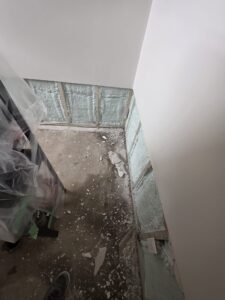
Use an industrial duster similar to an air purifier that has HEPA certification running to collect airborne dust and use a powerful blower (NOT a hair blower) to blow the wall so it can expose all cracks. It’s recommended to check the entire foundation around the home. Once blowing off the wall is complete, leave the area for at least one hour to let the dust settle down and be cleaned by the air duster.
2) Prepare to inject the cracks. The best products to use for injecting cracks are polyurethane (PU) injection resin or epoxy injection resin. Polyurethane is favored mostly in the industry for active leaks, and without leaks, the epoxy solution is used. Also get some hydraulic cement for extra protection.
Use plastic or metal ports with a ¼” or 3/8″ zerk fitting. Epoxy surface paste and cleaning materials such as wire brushes and degreasers. Safety equipment is highly recommended, like glasses, gloves, and respirators.
Equipment needed: For an injection gun, a dual cartridge is recommended. A hammer, drill, ⅜” masonry bit, putty knife, wrenches and pliers, and a utility knife.
3) Injection Procedure. Cover the floor. Clean the area meticulously with the wire brush, blow, and vacuum the cracks to clear out loose concrete debris. Mark the crack points with a pencil or marker. First point at the bottom: place ports 6-12 inches. Use the putty knife to spread and press into place. Cover fully but leave the port exposed. Leave it for one and half hours to cure properly.
Load the injection gun and attach the mixture nozzle. Mix properly and test to make sure it’s mixed well. Remember, epoxy is the best choice if it’s not already leaking.
Starting at the lowest port, inject carefully, not too fast. It will come up to the next port. Cap it once you are done. Repeat this if there are multiple ports. We want to make sure this pushes out any trapped air, so look for any bubbles; if there are any, you continue until it becomes consistent and thick without any bubbles. Use a putty knife to shape and clean any excess. Leave the application for 24 hours to cure properly.
4) Finishing the application. Clean the area, cut off excess and ports, and scrape and clean the area. If there is any bulge, grind or sand it smooth and apply hydraulic cement across it for added stability.
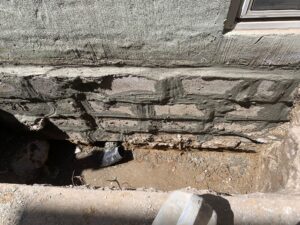
Allow the application to cure. Run the duster/air cleaner again for a while, and you can now reinstall the drywall.